




| November 10, 2026
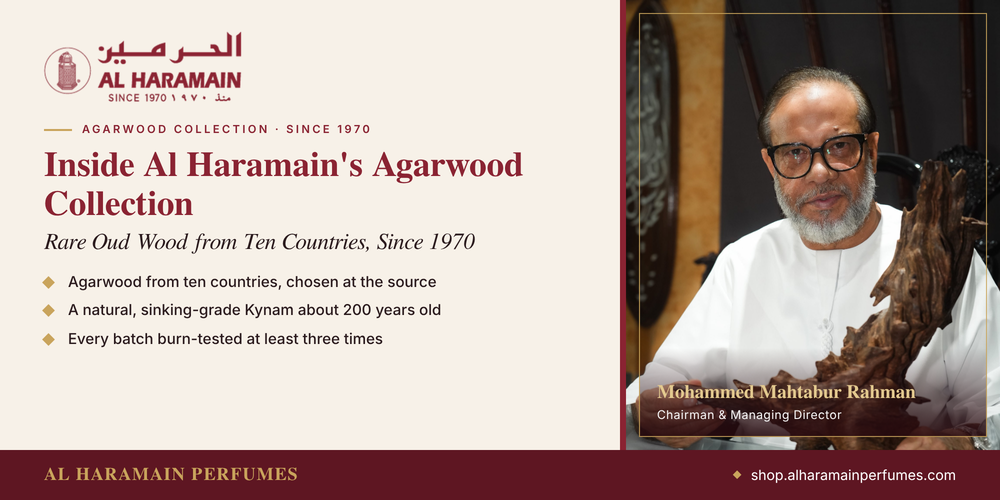
Most perfume houses add oud to their range at some point. Al Haramain started with it. In 1970, the late Mohammed Kazi Abdul Haque opened a small store near Al Haram Mosque in Makkah, trading agarwood, Dehn Al Oudh and other precious perfume materials. More than 55 years later, agarwood is still at the heart of Al Haramain Perfumes.
Today the house holds one of the largest agarwood and Dehn Al Oudh collections in the GCC, the six Gulf states of Saudi Arabia, the UAE, Kuwait, Qatar, Bahrain and Oman. It covers wood from ten countries and every grade, from fine powder to a natural, sinking-grade Kynam about 200 years old. Here is what the collection holds, where the wood comes from and how each piece is chosen.
| Field | Detail |
|---|---|
| Founded | 1970 in Makkah, Saudi Arabia, by the late Mohammed Kazi Abdul Haque |
| Experience in agarwood | More than 55 years |
| Origins | Vietnam, Burma (Myanmar), the Philippines, Indonesia, India, Bangladesh, Cambodia, Laos, Malaysia and Sri Lanka |
| Rarest piece | A natural, sinking-grade Kynam, about 200 years old |
| Showpieces | A 7.4 kg Burmese piece valued at AED 10 million and a 2.4 kg Vietnamese piece valued at AED 3 million |
| Range | Powder, everyday chips, premium chips, Dehn Al Oudh and collector pieces |
| Scale | From a few grams for home use to wholesale stock measured in tonnes |
| Quality check | Every batch is burn-tested at least three times |
| Natural only | All agarwood and Dehn Al Oudh comes from real wood, never synthetic oud |
Much of the range can be bought online. Al Haramain's agarwood collection includes wood from Burma, Cambodia, the Philippines, India, Malaysia and Kalimantan in Indonesia, sold as chips in several grades and as fine powder.
Al Haramain did not add agarwood to a perfume business. It began as an agarwood business, and everything else grew from it. Each stage of its history brought the house closer to the source: from trading wood in Makkah, to buying at origin across South and Southeast Asia, to grading and processing agarwood in its own facilities in Ajman, UAE.
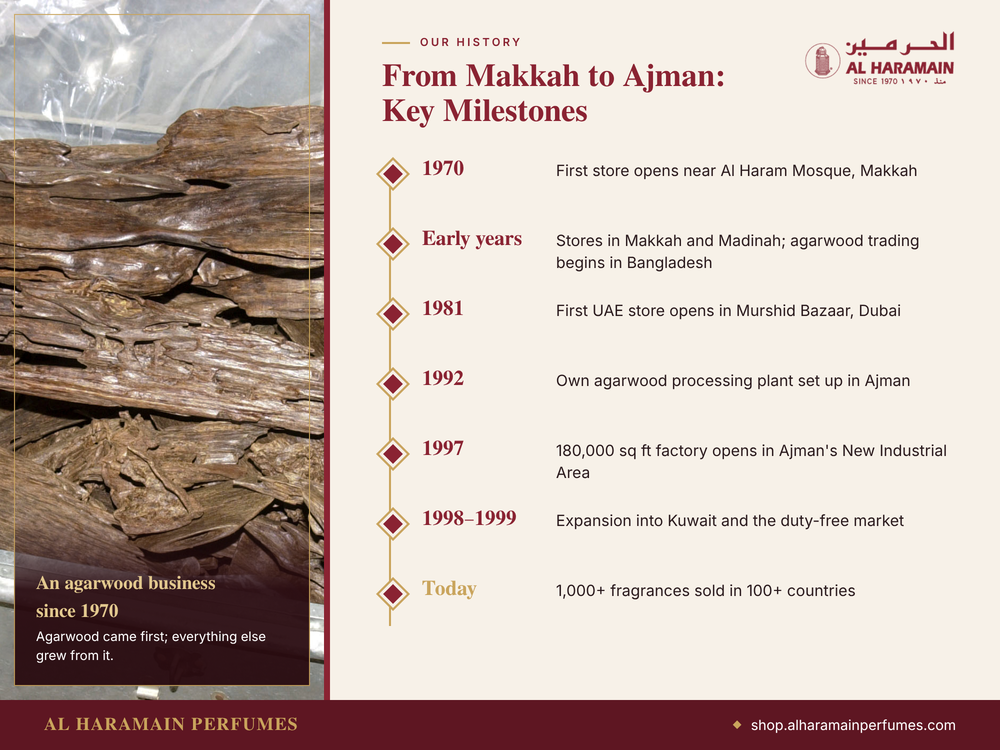
| Year | Milestone |
|---|---|
| 1970 | The late Mohammed Kazi Abdul Haque opens a store near Al Haram Mosque in Makkah, trading agarwood, Dehn Al Oudh and precious perfume materials |
| Early years | Stores open in Makkah and Madinah, and the house begins trading agarwood in Bangladesh, close to the region's agarwood forests |
| 1981 | The first UAE store opens in Murshid Bazaar, Dubai |
| 1992 | Al Haramain sets up its own agarwood processing and manufacturing plant in Ajman |
| 1997 | A 180,000 sq ft factory opens in Ajman's New Industrial Area |
| 1998–1999 | Expansion into Kuwait and the duty-free market |
| Today | Over 1,000 fragrances sold in more than 100 countries, and wholesale agarwood supply measured in tonnes |
Five decades of trading have built something that is hard to copy: relationships. Al Haramain has spent its whole history working with collectors, distillers and forest communities across Asia. Few houses can draw on as many trusted sources, or on as much experience in judging wood.
That experience matters because agarwood can't be judged from a photo or a price list. Two pieces from the same country can smell completely different, and the gap between an everyday chip and a premium one is often clear only to someone who has handled thousands of them.
It matters more every year, too. Al Jazeera's investigation into the oud trade found that, kilo for kilo, the best oud costs more than gold, and that high-quality wood is becoming harder to find. When good agarwood is scarce, knowing where to find it and how to judge it is what separates one collection from another.
The founder's son, Mohammed Mahtabur Rahman, is Chairman and Managing Director of the Al Haramain Perfumes Group of Companies. He has spent 50 years selecting amber and agarwood, and he still chooses the most important pieces himself.
He also takes rare agarwood to fragrance exhibitions and shares it on social media, so that people can see, touch and smell oud in its natural form, not only as a finished perfume.
The best agarwood doesn't come to the city. The chairman personally visits forests in Kalimantan, the Indonesian part of Borneo, in Sumatra, and in many other parts of Indonesia to find unique raw material. Some of these places lie deep inside the forest and can take weeks to reach.
The house's rarest wild agarwood, and its Kynam, came from the chairman's own sourcing. Going to the forest means seeing the wood before it has passed through other hands, judging it on the spot, and building long-term relationships with the local collectors who find it. Kalimantan wood is part of the everyday range too: Al Haramain's Kalimantan agarwood is one of the Indonesian origins sold online.
Al Haramain works on one simple belief: great oud can only come from great agarwood. Every piece follows the same path before it reaches a customer.
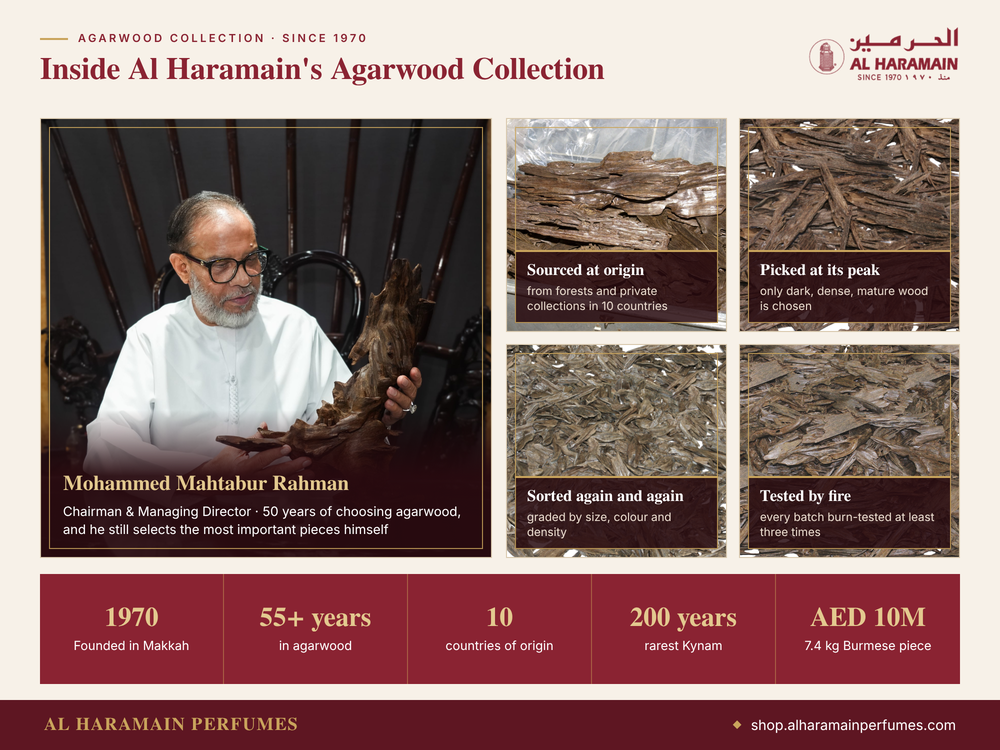
Burning is the final test for a good reason. It is the only one that shows how the wood will actually smell in someone's home. A chip can look perfect and still give a thin or sharp smoke, and the fire test catches it.
One of the oldest ways to grade agarwood is to place it in water. Healthy wood from the tree is pale and light, so it floats. As resin builds up inside the wood over many years, it becomes denser, and the most resin-rich pieces sink. That is where the Chinese name for agarwood, chen xiang, comes from: it means "sinking fragrance".
| In water, the piece… | What it shows | Grade |
|---|---|---|
| Sinks to the bottom | Dense and saturated with resin | Highest (sinking grade) |
| Sinks below the surface but doesn't touch the bottom | Well resinated | High |
| Floats | Less resin | Everyday grades |
Sinking isn't required for agarwood to be genuine. Many good-quality pieces float, and scent and origin matter as much as density. But a piece that goes straight to the bottom has built up resin over a very long time, which is why sinking grades are the most prized of all.
Kynam, also written Ky Nam or Qi Nan, is the rarest grade of agarwood in the world. It is soft, rich in resin and fragrant even at room temperature, without any heat. Very little true Kynam is found each year, mostly from old wild trees in Vietnam.
Al Haramain's finest piece is a natural Kynam from the forest, about 200 years old. It is sinking grade: placed in water, it goes straight to the bottom. Only wood that has built up resin over generations can do that, and no plantation can make a piece like it. True rarity can't be rushed, and the finest agarwood needs a couple of centuries of slow, natural resin growth inside the tree.
The collection's two best-known showpieces are a 7.4 kg piece of Burmese (Myanmar) agarwood valued at AED 10 million, about US2.72million, anda2.4kgVietnamesepiecevaluedatAED3million, aboutUS817,000. That puts both at well over a million dirhams per kilogram: roughly AED 1.35 million per kg for the Burmese piece and AED 1.25 million per kg for the Vietnamese one.
Size is part of what makes them rare. Resin forms in patches around old wounds in the tree, so most agarwood reaches the market as chips and slivers. A single solid piece weighing several kilograms is exceptional. (US dollar figures use the fixed rate of AED 3.6725 to US$1, rounded.)
Beyond these two, the collection holds many more rare and antique pieces, in both quantity and top quality. They include sinking-grade wood from several origins, each valued for its age, its weight and the smooth, deep smoke it gives when warmed.
Origin shapes the scent of agarwood more than anything else. The same grade from two countries can smell completely different, which is why oud lovers talk about origins the way coffee lovers talk about beans. Al Haramain holds wood from all ten origins below, and the scent comes only from the natural wood of the agarwood tree.
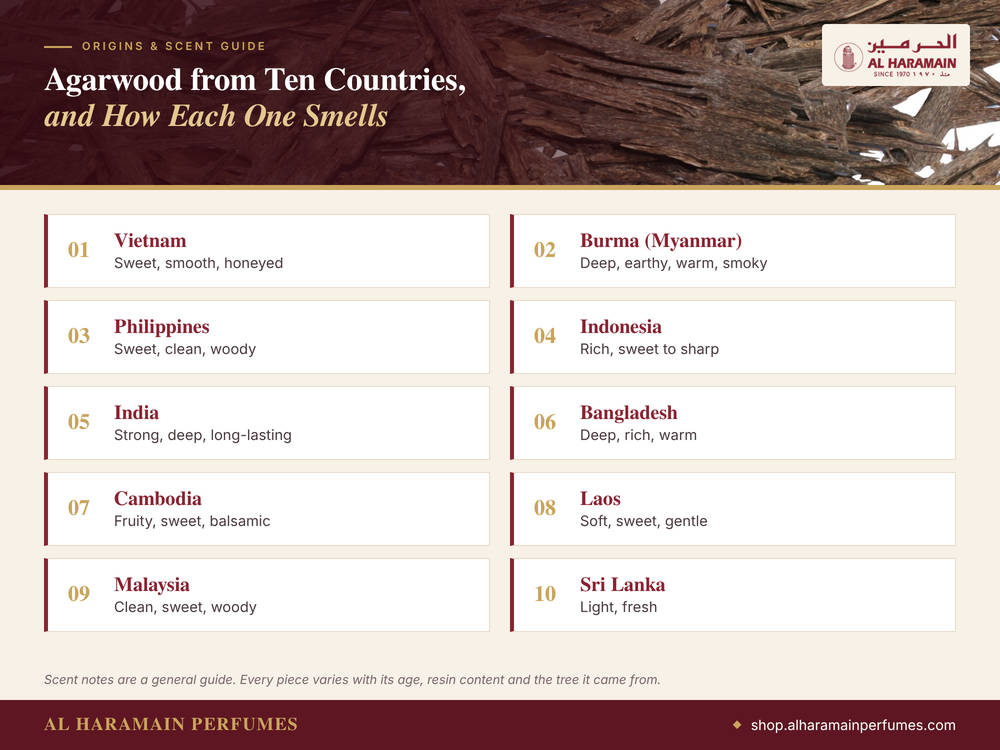
| Country | What Al Haramain holds | Scent |
|---|---|---|
| Vietnam | Premium wild agarwood and Kynam | Sweet, smooth, honeyed |
| Burma (Myanmar) | Large natural pieces, including the 7.4 kg showpiece, and Al Haramain's Burma agarwood | Deep, earthy, warm, smoky |
| Philippines | Premium wood, including Al Haramain's Philippine agarwood | Sweet, clean, woody |
| Indonesia | Rare wild pieces from deep forest, including Kalimantan and Sumatra | Rich, sweet to sharp |
| India | Finished agarwood, cleaned and graded | Strong, deep, long-lasting |
| Bangladesh | Natural agarwood from the region's forests | Deep, rich, warm |
| Cambodia | Wood from the Cambodian jungle, including Al Haramain's Cambodia Super agarwood | Fruity, sweet, balsamic |
| Laos | Several grades | Soft, sweet, gentle |
| Malaysia | Several grades | Clean, sweet, woody |
| Sri Lanka | Several grades | Light, fresh |
These scent notes are a general guide. Every piece differs with its age, its resin content and the tree it came from, which is why the burn test matters as much as the label.
The collection is built to serve every oud lover, from someone buying their first chips to a serious collector.
Dehn Al Oudh, burning oud at home and trade supply each have their own part in this series.
All of Al Haramain's agarwood and Dehn Al Oudh comes from real wood. The house does not use synthetic oud accords in these products. Every chip, every drop of oil and every piece in the collection comes from genuine agarwood.
Wild agarwood is also a protected resource. According to the UN Food and Agriculture Organization, Aquilaria malaccensis was listed in Appendix II of CITES, the convention that controls trade in endangered species, in 1995, and the other agarwood-producing species followed in 2004. Appendix II doesn't ban the trade. It means agarwood has to move between countries with the right permits and records. Al Haramain imports its wood with the CITES permits required, and it provides trade buyers with the legal documents and support needed for export.
Al Haramain has traded agarwood since 1970, when the late Mohammed Kazi Abdul Haque opened a store near Al Haram Mosque in Makkah. That makes more than 55 years in the agarwood business. The house began trading wood in Bangladesh in its early years, opened its first UAE store in Dubai in 1981 and set up its own agarwood processing plant in Ajman in 1992. Agarwood is still the heart of the business today.
Al Haramain sources agarwood from ten countries: Vietnam, Burma (Myanmar), the Philippines, Indonesia, India, Bangladesh, Cambodia, Laos, Malaysia and Sri Lanka. Wood is bought at the origin, from forest collectors and from the private collections of merchants and connoisseurs. The chairman also visits forests himself, including in Kalimantan, Sumatra and other parts of Indonesia, to find rare wild pieces. Everything is then graded and tested in Ajman.
The rarest piece is a natural Kynam about 200 years old. It is sinking grade, which means it goes straight to the bottom when placed in water, a sign of resin built up over generations. The collection also holds two famous showpieces: a 7.4 kg Burmese piece valued at AED 10 million and a 2.4 kg Vietnamese piece valued at AED 3 million. Many other rare and antique pieces sit alongside them.
Kynam, also written Ky Nam or Qi Nan, is the rarest grade of agarwood in the world. It is soft, very rich in resin and fragrant even without heat, which sets it apart from ordinary agarwood that needs warming to release its scent. Very little true Kynam is found each year, mostly from old wild trees in Vietnam. Because it takes so long to form, it can't be produced on plantations.
Not all real agarwood sinks, and sinking isn't a requirement for wood to be genuine. Wood that is saturated with resin becomes denser than water, so it sinks; this is called sinking or underwater grade, and it is the most prized. Many high-quality pieces float or sit just below the surface. Scent, origin and how the wood burns matter as much as the water test.
Selection is led by Mohammed Mahtabur Rahman, Chairman and Managing Director of the Al Haramain Perfumes Group, who has 50 years of experience in choosing amber and agarwood. He chooses the most important pieces himself and personally sourced the house's Kynam and rarest wild wood. His team then sorts every piece by size, colour and density and burn-tests each batch at least three times.
Yes. All of Al Haramain's agarwood and Dehn Al Oudh comes from real agarwood, and the house does not use synthetic oud accords in these products. Because agarwood is protected under CITES Appendix II, it is imported with the permits required for international trade. Trade buyers who export agarwood receive the legal documents and support they need from Al Haramain.
You can buy agarwood on Al Haramain's global online store and through its country stores, which include Saudi Arabia, Qatar, Bahrain, Oman, Kuwait, Bangladesh, Morocco, Australia, the USA, and the UK and Europe. The range varies by country, so check your local store for the origins and grades available. For collector pieces or wholesale volumes, contact the oud team on WhatsApp at +971 6 748 0555.
From a single store in Makkah in 1970 to wood from ten countries and a 200-year-old Kynam, Al Haramain has followed the same idea for more than five decades: great oud starts with great agarwood. That is why the chairman still travels to the forest, and why every batch is burned and judged before it is sold. To see the range for yourself, browse the full agarwood range on Al Haramain's global store, visit an Al Haramain showroom, or contact the oud team on WhatsApp at +971 6 748 0555 about collector pieces.


