




| November 10, 2026
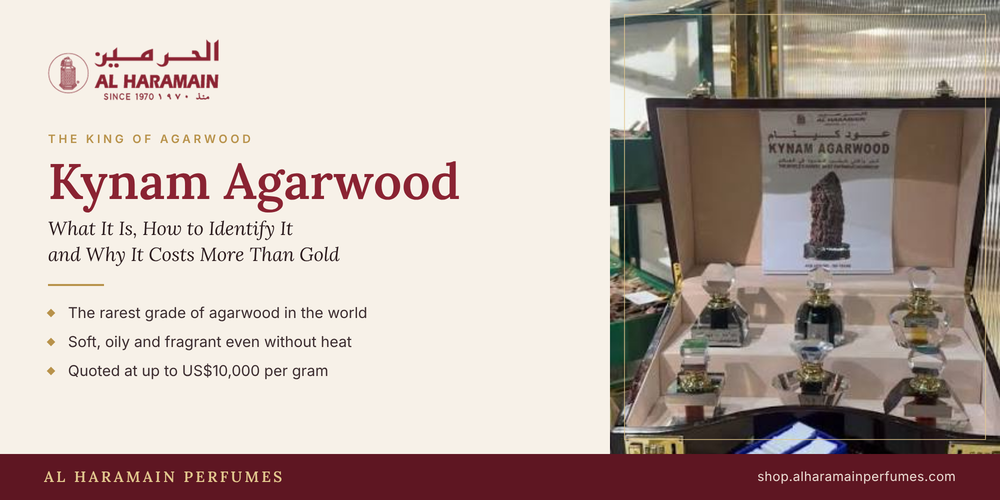
In China's Song dynasty, a piece of Kynam was said to be worth its weight in gold. Today, the finest pieces sell for many times more. Kynam is the rarest material in the world of oud, and very few people, even among keen oud lovers, have ever smelled the real thing.
Kynam agarwood is the highest and rarest grade of agarwood. It is a soft, extremely resin-rich wood from the Aquilaria tree that smells sweet and clear even before it is heated. It is also known as Ky Nam, Kinam, Qi Nan and, in Japan, Kyara, and top pieces have been quoted at up to US$10,000 per gram.
At Al Haramain Perfumes, oud has been at the heart of the house since it opened in Makkah in 1970, and its collection includes a natural, sinking-grade Kynam about 200 years old. This guide explains what Kynam is, its many names and types, how it forms, how to identify it, what it costs in the UAE and around the world, and why it is so expensive.
| Question | Answer |
|---|---|
| Other names | Ky Nam, Kỳ Nam, Kinam, Kyara, Kanankoh, Qi Nan, Qinan (奇楠), Calambac |
| What it is | The rarest, most resin-rich grade of agarwood |
| Source tree | Aquilaria, mainly A. crassna and A. sinensis |
| Main origins | Vietnam, southern China, Cambodia and other parts of Southeast Asia |
| What makes it different | Soft, oily texture and a clear, sweet scent without heat |
| Wild or cultivated | Wild Kynam is old natural wood; grafted Kynam is now grown in China |
| Price | From about US$50 per gram for grafted resin to US$10,000 per gram for top wild pieces |
| Legal status | All agarwood species are protected under CITES Appendix II |
Kynam is a rare form of agarwood, the fragrant, resin-filled wood that forms inside the Aquilaria tree. Ordinary agarwood forms when the tree is wounded and infected, and it fills the damaged wood with dark, scented resin to protect itself. Most of that wood smells faint when cold and needs heat to release its scent.
Kynam is different. It holds so much resin, and resin of such a special kind, that the wood is soft, oily and slightly sticky rather than hard and dry. It gives off a clear, sweet scent at room temperature, and when it is gently warmed, it opens into a rich, layered fragrance that changes over time. That is why collectors in China, Japan, Vietnam and the Gulf treat it as a class of its own, rather than simply a better grade of oud.
If you are new to oud, Al Haramain's guide to what oud is explains the basics of agarwood before you go further into Kynam.
Kynam has been traded for well over a thousand years, so it has picked up a name in almost every language along the way. They all point to the same idea: the very top of agarwood.
| Name | Language or region | Meaning or use |
|---|---|---|
| Kỳ Nam, Ky Nam, Kynam | Vietnamese | The most common name in the oud trade today |
| Kinam | Trade spelling | Used by many Gulf and Western sellers |
| Qi Nan, Qinan (奇楠) | Chinese | Qi suggests something rare or special; nan is a group of fragrant woods |
| Kyara (伽羅) | Japanese | The top rank of incense wood in Japanese kōdō |
| Kanankoh | Japanese | Another Japanese name for Kynam |
| Calambac | Historical trade name | Used in older European and Vietnamese records |
| Kala-nam | Sanskrit records | An early name recorded in Sanskrit sources |
You will also see Kynam called "the king of agarwood" or "the king of oud". These are not formal grades, but they show how highly it is ranked.
Alt text: The many names of Kynam: Ky Nam, Kinam, Qi Nan, Kyara, Kanankoh and CalambacAgarwood is usually graded by its resin, which shows in its colour, weight, density and scent. Most systems run from everyday chips at the bottom to dense, dark, sinking-grade wood at the top. Kynam sits above all of them. It is not simply wood with more resin; its resin behaves differently, which is why it is soft rather than hard and fragrant without heat.
To see where Kynam sits next to Super, Double Super and sinking wood, read Al Haramain's guide to agarwood grades.
Chinese records have prized Kynam for centuries. According to the collector and researcher behind the Kyarazen archive, during the Song dynasty one tael of Kynam was valued at one tael of gold, and under the Ming dynasty the saying became one inch of Kynam for one inch of gold. Even earlier, Western Jin texts describe a soft, pliable, honey-like fragrant wood that sounds much more like Kynam than ordinary agarwood.
Vietnam is the land most closely linked with Kynam. On bronze urns of the Nguyen dynasty in Huế, two trees are carved among the treasures of the country: one for ordinary agarwood (trầm hương) and one for Kynam. Both were imperial tribute items, a sign of how highly the royal court valued them.
In Japan, Kynam is known as Kyara, and it holds the top place in kōdō, the "way of incense". Japanese incense masters sort aromatic woods into six types, known as rikkoku, and judge them by five tastes (gomi): sweet, sour, hot, bitter and salty. Kyara is the most prized of the six. In a kōdō ceremony, a tiny sliver is placed on a thin mica plate above charcoal buried in ash, so the wood is warmed rather than burned, and guests "listen" to its scent.
In the Gulf, oud is part of daily life. It is burned to welcome guests, to scent clothes before Friday prayers and to fill the home during Ramadan and Eid. Fine oud has long been a sign of generosity and respect in the majlis, and the rarest wood, including Kynam, is kept for the most special guests and occasions. Arabian perfume houses that began as oud traders, Al Haramain among them, built their names on finding and keeping exceptional wood.
Healthy Aquilaria wood is pale and has almost no scent. When the tree is wounded, by lightning, insects, animals or a broken branch, fungi enter the wood. The tree fights back by filling the area with resin, and over many years that resin turns the wood dark, heavy and fragrant. This is how all agarwood forms.
Kynam starts the same way, but something more happens. Exactly what remains one of the great open questions in the world of oud.
No one has fully explained why a tiny number of trees produce Kynam while their neighbours produce ordinary agarwood. Collectors and researchers have suggested several reasons:
Many collectors believe it is a combination of these factors, rather than any one alone.
Kynam from Vietnam and Cambodia is usually linked to Aquilaria crassna, and Chinese Kynam to Aquilaria sinensis. Aquilaria malaccensis has also been suggested for some wild wood. For old wild Kynam, these links are based on where the wood is found rather than on firm proof, because the wood alone does not always show which species it came from. For grafted Kynam, DNA tests reported in a 2023 study place it close to Aquilaria sinensis.
For a wider look at the Aquilaria tree and how agarwood is harvested, see Al Haramain's complete guide to agarwood.
Two compound groups give agarwood its scent: 2-(2-phenylethyl)chromones, often shortened to PECs or chromones, and sesquiterpenes. Scientists have found clear differences in how Kynam carries them.
In simple words, Kynam is not just "more" agarwood. It carries more resin, a different balance of scent compounds, and at least one compound that ordinary agarwood seems to lack.
There is no single official system for Kynam types. Sellers, collectors and researchers group it in four main ways: by how it formed, by origin, by colour and by form.
This is the most important difference for any buyer today.
Wild Kynam forms naturally in old forest trees, over decades or even centuries. It is found by chance, often in fallen or buried wood, and there is no way to tell from the outside whether a tree holds it. Most wild Kynam on the market today is old stock, and it is the Kynam behind the famous prices.
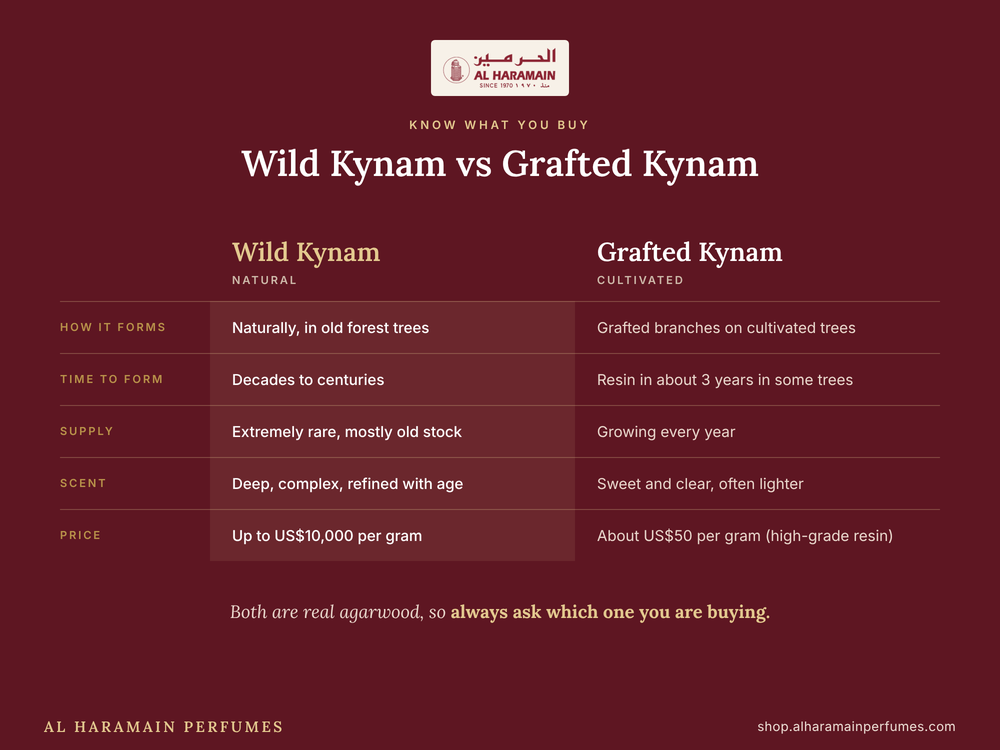
Grafted Kynam, also called cultivated Kynam or green Kynam, is a newer story. Growers in southern China take branches from trees known to produce Kynam and graft them onto hardy Aquilaria sinensis rootstock. The trees are then wounded to start resin formation. China Daily reported in 2025 that in Huidong county, Guangdong, grafting survival rates have passed 80%, some trees yield resin in about three years, and high-grade green Kynam resin can sell for more than US$50,000 per kilogram. The county alone had nearly 1,100 hectares of plantations across 128 businesses.
| Feature | Wild Kynam | Grafted Kynam |
|---|---|---|
| How it forms | Naturally, in old forest trees | Grafted branches on cultivated trees, then wounded |
| Time to form | Decades to centuries | Resin in about 3 years in some trees |
| Supply | Extremely rare, mostly old stock | Growing every year |
| Scent | Deep, complex and refined with age | Sweet and clear, often lighter and less complex |
| Typical price | Up to US$10,000 per gram for top pieces | Over US$50,000 per kg (about US$50 per gram) for high-grade resin |
| Accepted as Kyara in Japan? | Yes, at the top grades | Traditional kōdō experts do not regard it as true Kyara |
Grafted Kynam is real agarwood with a Kynam character, and many people enjoy it. The problem comes when it is sold as wild Kynam at a wild Kynam price, so always ask which one you are buying.
| Origin | What it is known for | Notes |
|---|---|---|
| Vietnam | The historic home of Kynam; sweet, honeyed, complex | The most prized wild Kynam |
| China (south) | Chinese Kynam from A. sinensis; centre of grafted Kynam | Guangdong is now the heart of grafted production |
| Cambodia | Wild Kynam linked to A. crassna | Rare; sometimes compared with Vietnamese wood |
| Thailand and Laos | Wild Kynam reported by collectors | Darker colour types are often linked to Thailand |
| Borneo and Indonesia | "Borneo Kynam" sold by some specialist houses | A trade name; collectors debate whether it is true Kynam |
In China and Vietnam, traders often describe Kynam by the colour of its resin. Green Kynam is the best known, and the name is now also used for much of the grafted Kynam from China. Yellow Kynam, purple Kynam, black Kynam and white Kynam are also traded. Collectors on specialist forums often link green and yellow Kynam with Vietnam, and purple and black Kynam with Thailand.
High-end dealers in Hong Kong use further names, such as golden silk Kynam and silver silk Kynam, for wood with fine, shiny resin streaks. In Japan, top Kyara is sometimes described by its "oil", such as green oil, black oil, yellow oil and white oil Kyara.
Keep in mind that these are trade names rather than official grades. Two sellers may use the same colour name for very different wood, so the colour name alone tells you little about quality.
If you prefer to wear oud rather than burn it, Al Haramain's Dehnal Oudh range brings together pure oud oils from different origins.
| Feature | Ordinary agarwood | Kynam |
|---|---|---|
| Scent when cold | Faint, woody | Clear, sweet, noticeable |
| Texture | Hard and dry | Soft, oily, slightly sticky |
| Resin | Varies with grade | Exceptionally high |
| Chemistry | Chromones and sesquiterpenes | More chromones, and compounds not found in ordinary samples |
| When warmed | Rich smoke, scent rises quickly | Gentle, layered scent that keeps changing |
| Rarity | Widely available | Extremely rare in the wild |
| Price | A few dirhams to thousands of dirhams per kilogram | Up to thousands of dollars per gram |
Sinking agarwood holds so much resin that it is denser than water. It is among the most valuable ordinary agarwood, and many people confuse it with Kynam. They are not the same. Most sinking wood is hard and needs heat to release its scent, while Kynam is soft and fragrant cold. Some Kynam sinks, as the 2018 study and Al Haramain's own 200-year-old piece show, but sinking alone does not make wood Kynam.
For most practical purposes, yes. Kynam, Qi Nan and Kyara are names for the same top-grade agarwood in Vietnam, China and Japan. There are small differences in how the words are used, though.
| Feature | Kynam / Qi Nan | Kyara |
|---|---|---|
| Where the name is used | Vietnam, China, the Gulf and the oud trade | Japan |
| What it means | The rarest, softest, most fragrant agarwood | The top rank of the six incense woods in kōdō |
| How strictly it is used | Loosely by some sellers, including for grafted wood | Strictly, by trained incense masters |
| How it is judged | Texture, cold scent, warmed scent, price | Scent on a mica plate, judged by the five tastes |
The loose use of "Kynam" is worth knowing about. Some sellers apply the name to lighter, harder wood that a Japanese expert would class as Sasora, a different type of incense wood. Kyarazen notes that the price difference between true green-oil Kyara and Sasora can be more than tenfold, so the name on the label really matters.
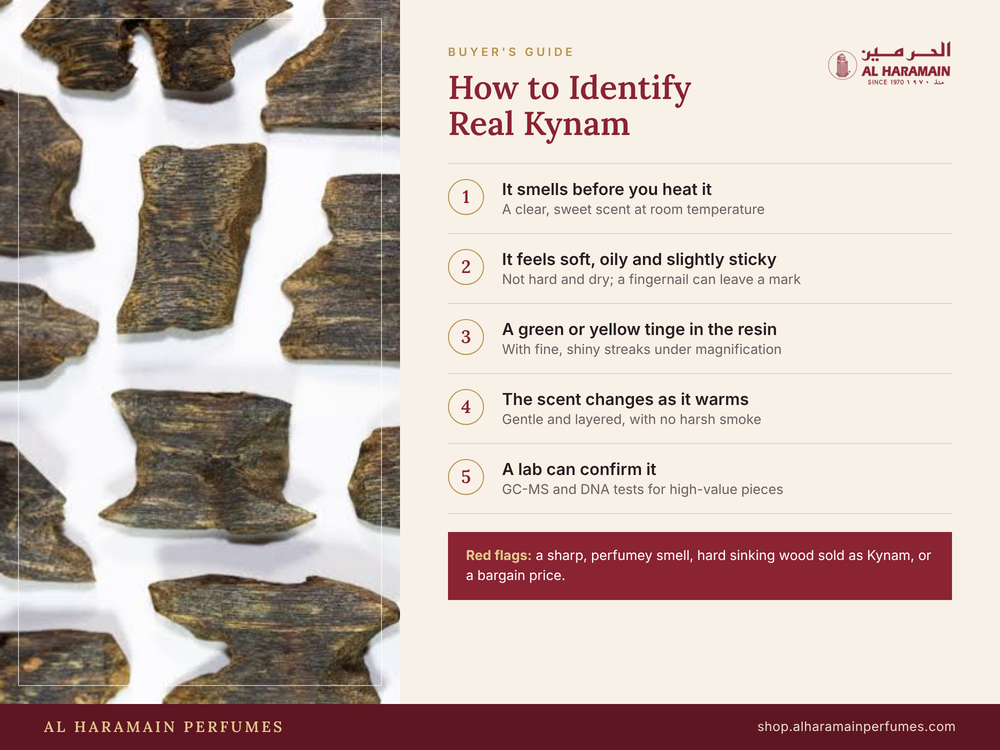
Real Kynam is very hard to confirm without years of experience or a laboratory. Still, there are clear signs to look for, and knowing them will help you ask the right questions.
This is the best-known sign. Hold genuine Kynam close and you will notice a clear, sweet, slightly cool scent, without any heat. Specialists describe the best pieces as strong enough to scent a room on their own. Ordinary agarwood, even very good wood, smells faint when cold.
True Kynam is pliable rather than hard. The surface often feels slightly moist or sticky because of the resin, and a fingernail can leave a mark. Hard, dry and rough wood is unlikely to be top Kynam, however dark it looks.
Experts often look for a green or yellow tinge in the resin, along with fine, shiny streaks that show clearly under magnification. Colour alone proves nothing, but it is one more clue.
The real test is warming. Place a tiny sliver on a mica plate or on an electric burner at low heat. Real Kynam opens slowly into a sweet, creamy, cool and gently spicy scent that keeps changing for a long time, without harsh smoke. Ordinary wood gives a stronger smoke and a simpler scent that fades faster. Al Haramain's guide to burning oud explains how to use an electric burner at low heat.
For a high-value purchase, a laboratory can test the wood. Gas chromatography–mass spectrometry (GC-MS) shows the chemical profile, including the chromones that mark Kynam, and DNA tests can help tell grafted Kynam from other wood. Few buyers do this, but serious collectors increasingly ask for it.
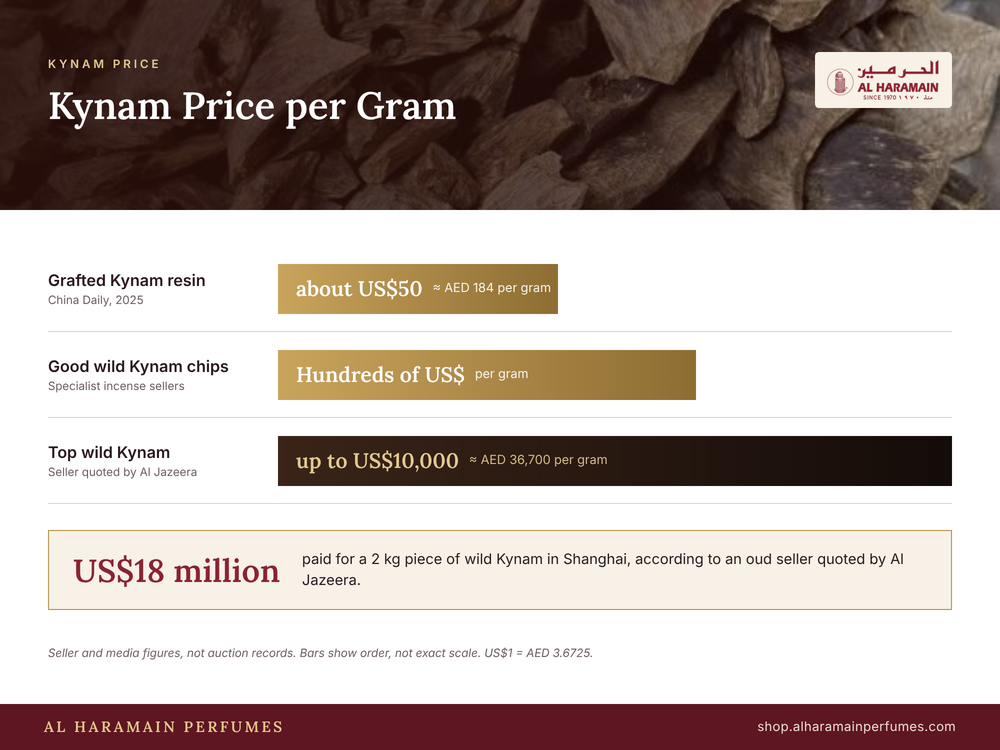
There is no public price list for Kynam. Prices depend on whether the wood is wild or grafted, its origin, age, resin content, softness, scent and size, and on who is buying. The table below brings together published figures, with their sources and dates. Dirham figures are converted at the fixed rate of US$1 = AED 3.6725.
| Item | Price | In dirhams | Source |
|---|---|---|---|
| Top wild Kynam, per gram | Up to US$10,000 | About AED 36,700 | Oud seller quoted by Al Jazeera (2016) |
| Wild Kynam, 2 kg sold in Shanghai | US$18 million | About AED 66 million | Same source |
| Wild Kynam, 16 kg from a 600-year-old tree | About US$20 million | About AED 73 million | Al Jazeera (2016); The Peak, Singapore (2020) |
| Kynam, 10 grams | Rs 85 lakh | About AED 355,000 | Kerala Kaumudi (October 2026), figure not sourced |
| High-grade grafted green Kynam resin | Over US$50,000 per kg | About AED 184 per gram | China Daily (June 2025) |
| Al Haramain Kinam Oudh Oil, 5 ml | US$5,250 | About AED 19,280 | Al Haramain global online store, at the time of writing |
The very high figures are seller and media accounts rather than public auction records, but they show the level at which true wild Kynam trades.
The price range per gram is huge because "Kynam" covers very different materials:
In the UAE, Kynam is a collector's material rather than a shelf product. It is usually sold by the gram or as a whole piece, through specialist oud houses and private dealers, and the price is agreed piece by piece after the buyer has smelled the wood. Kynam oil is sold by the millilitre or the tola (about 12 ml).
Expect top wild Kynam to cost tens of thousands of dirhams per gram, while grafted Kynam costs a small fraction of that. Al Haramain's Kinam Oudh Oil gives a sense of the scale: 5 ml is listed at US$5,250, about AED 19,280, on the global online store at the time of writing.
Most buyers in the UAE never need Kynam for everyday use. Fine wild agarwood, such as Al Haramain's Cambodia Super agarwood or its Philippine agarwood, offers a rich, natural oud experience at a far more accessible price. For a full picture of what oud costs from everyday chips to rare wood, see Al Haramain's agarwood price guide for the UAE.
In Japan, Kyara is sold by the gram, and prices depend on its grade within the kōdō tradition. Raw Kyara chips can cost hundreds of euros per gram, and the finest pieces cost far more. A 2018 scientific paper cited a figure of about €350 per gram for Kynam. Lighter woods sold under the Kyara or Kynam name, such as Sasora, cost far less, by more than ten times according to Kyarazen.
Kynam's price comes from a rare mix of scarcity, mystery and demand.
That is why, according to Kyarazen, historic Kynam can cost several times the price of gold per gram, and in the Chinese market twenty times or more. To see how Kynam compares with other record-breaking oud, read about the most expensive agarwood in the UAE.
Kynam should never be placed on hot charcoal, which burns it too fast and wastes it. Use a tiny sliver on an electric burner at its lowest setting, and let the scent rise slowly. One small piece can be warmed several times. Many people keep Kynam for the most special guests or occasions, such as Eid or a wedding, while using everyday oud or Al Haramain's bukhoor collection for daily fragrance at home.
In kōdō, Kyara is warmed on a mica plate over buried charcoal, and guests pass the incense burner around and "listen" to the scent. It is a quiet, careful practice, and it is the reason Japan has kept such precise standards for what can be called Kyara.
Kynam oil is distilled from Kynam wood, and because there is so little wild Kynam, true Kynam oil is extremely rare. It is worn in tiny amounts on the skin or clothes, like any fine Dehn Al Oudh. Al Haramain's Kinam Oudh Oil, described as Wild A+++ grade, sits at the very top of the house's oils. For a smooth, aged oud oil at a more everyday price, many people choose an ateeq oil such as Dehnal Oudh Maliki Ateeq.
Kynam beads and bracelets are popular in China, where they are worn for their scent, which warms with the body. Most are now made from grafted Kynam, and fakes are common, so the same buying rules apply.
Because Kynam is so valuable, it attracts more fakes and false labels than any other oud. Use this checklist before you buy:
Al Haramain began in 1970 as a small store near Al Haram Mosque in Makkah, trading agarwood and Dehn Al Oudh. More than 55 years later, agarwood is still at the heart of the house. Its chairman personally visits forests in Kalimantan, Sumatra and other parts of Indonesia to find rare wood, and every batch of agarwood is burn-tested at least three times before it is approved.
The rarest piece in the collection is a natural Kynam from the forest, about 200 years old. It is sinking grade: placed in water, it goes straight to the bottom, something only wood that has built up resin over generations can do. You can read more about this piece and other showpieces in the story of Al Haramain's agarwood collection.
For everyday and premium wood from many origins, browse Al Haramain's agarwood collection. For rare and collector pieces, the oud team can be contacted on WhatsApp at +971 6 748 0555, or you can visit one of Al Haramain's showrooms in the UAE.
Kynam is the rarest and most valuable kind of agarwood, the fragrant wood of the Aquilaria tree. It holds so much resin that it is soft and oily, and it smells sweet even before you heat it. It is mostly found in old wild trees in Vietnam and nearby countries. Because so little exists, it is the most expensive oud in the world.
Yes, in most cases. Kynam (Vietnamese), Qi Nan (Chinese) and Kyara (Japanese) all name the top grade of agarwood. The main difference is how strictly the word is used. In Japan, Kyara is a fixed rank judged by trained incense masters, while some sellers elsewhere use "Kynam" more loosely, including for grafted or lighter wood.
It depends mainly on whether it is wild or grafted. High-grade grafted Kynam resin has been reported at over US$50,000 per kilogram, about US$50 per gram, while top wild Kynam has been quoted at up to US$10,000 per gram. Good wild chips usually fall somewhere in between. Origin, age, softness and scent all move the price within that range.
Kynam in the UAE is sold by specialist oud houses and dealers, usually by the gram or as a whole piece, and the price is agreed after the buyer has smelled the wood. Top wild Kynam can reach tens of thousands of dirhams per gram, about AED 36,700 at the highest quoted level, while grafted Kynam costs far less. For Kynam oil, Al Haramain's Kinam Oudh Oil gives a useful reference point: it is listed at US$5,250 (about AED 19,280) for 5 ml on the global online store at the time of writing.
Kynam forms in only a tiny number of wild trees, takes decades or centuries to develop, and cannot be predicted or found on demand. At the same time, collectors in China, Japan and the Gulf compete for it, and many treat it as a store of value. Historical Chinese records already compared it with gold, and according to Kyarazen, historic Kynam can now cost several times, or even twenty times or more, the price of gold per gram.
Real Kynam smells sweet and clear without heat, feels soft, oily and slightly sticky, and gives a gentle, layered scent that keeps changing when warmed at low heat. Hard, dry wood with a faint cold scent is unlikely to be Kynam, and a sharp, perfumey smell can mean the wood has been soaked in oil. For a valuable piece, buy from a trusted oud house and, if possible, ask for a laboratory test.
Yes, in a form known as grafted or cultivated Kynam. Growers in southern China graft branches from Kynam-producing trees onto Aquilaria sinensis rootstock, and some trees yield resin in about three years. Grafted Kynam has a Kynam character and is much cheaper than wild Kynam, but it lacks the age and depth of old wild wood, and traditional Japanese experts do not regard it as true Kyara.
Green Kynam is Kynam whose resin has a green tinge, and it is one of the most prized colour types in the trade. Today the name is also widely used for grafted Kynam grown in southern China. Because the same name covers both wild and grafted wood, always ask the seller which one you are buying.
Yes. This is one of the clearest differences between Kynam and ordinary agarwood. Genuine Kynam gives off a clear, sweet scent at room temperature, and the finest pieces can scent a room without heat. Ordinary agarwood usually smells faint until it is warmed.
Kynam is often described as sweet, honeyed and creamy, with cool, gently spicy and slightly bitter notes underneath. When it is warmed, the scent unfolds in stages and keeps changing for a long time. Japanese incense masters judge it by five tastes, sweet, sour, hot, bitter and salty, and the finest Kyara is prized for showing them in balance.
Kynam is agarwood, and all agarwood species are listed under CITES Appendix II, which means international trade is allowed but controlled by permits. Buying Kynam from a legitimate seller within the UAE is normal, and established oud houses handle the documents for imported wood. If you plan to bring Kynam into or out of the country yourself, check the current rules with the UAE Ministry of Climate Change and Environment before you travel.
Keep Kynam in an airtight glass jar or a sealed wooden box, away from heat, direct sunlight and strong smells. Do not store it in plastic for long periods, as the wood can pick up unwanted odours. Stored well, Kynam keeps its scent for many years, and many collectors believe it improves with age.
Kynam is where agarwood stops being a simple ingredient and becomes something closer to treasure. It is soft where other oud is hard, fragrant where other oud is silent, and so rare that its price has been compared with gold for almost a thousand years. Today, grafted Kynam has made a version of its scent more widely available, but true wild Kynam remains as scarce as ever.
Whether you are curious about Kynam or ready to buy, the most important rules are simple: know whether the wood is wild or grafted, smell it before you heat it, and buy only from a source you trust. To see fine agarwood for yourself, browse Al Haramain's agarwood collection online, visit an Al Haramain showroom, or contact the oud team on WhatsApp at +971 6 748 0555.


