Agarwood Price Guide: How Much Does Oud Wood Cost in the UAE?
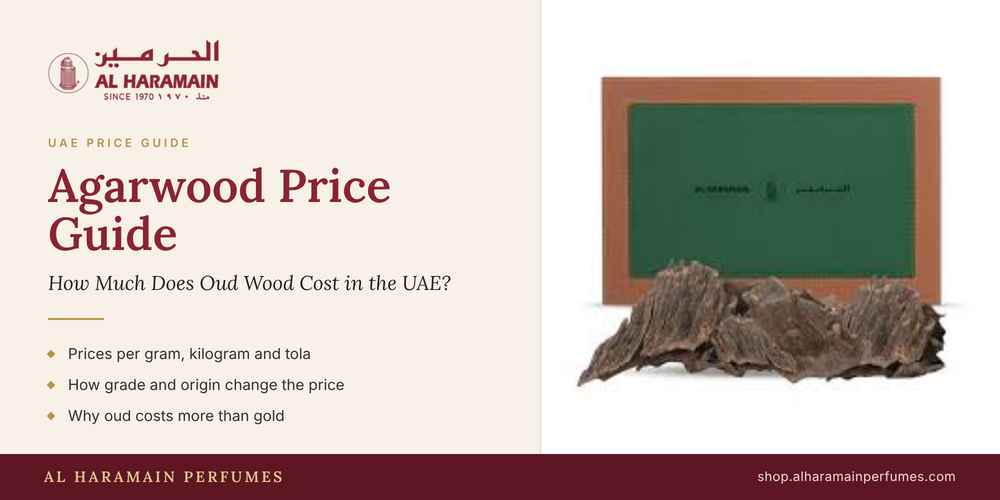
Ask ten oud sellers in the UAE what agarwood costs and you'll get ten different answers, and all of them can be right. A small box of everyday chips can cost less than a family dinner, while a single kilogram of rare wood can cost as much as a car. At the very top, Kynam has been quoted at prices higher than gold.
In short, agarwood prices run from a few dirhams for powder and everyday chips to more than Dh100,000 per kilogram for rare wood, and the most exceptional Kynam has been quoted at up to US$10,000 per gram. What decides the price is grade, origin, age and form. This guide explains each one with real, dated figures, shows you how to read prices per gram, kilogram and tola, and helps you buy at a fair price, whether you shop at Al Haramain Perfumes or anywhere else.
Agarwood Prices at a Glance
Agarwood prices are rarely published, and most figures you'll find online have no source. The table below uses only figures from named sources, with the year where one is given.
| What you're buying | Price range | Source |
|---|---|---|
| Low-quality wood | A few US dollars per kg | UN Food and Agriculture Organization (FAO) |
| Top-quality wood | More than US$30,000 per kg (about AED 110,000) | FAO |
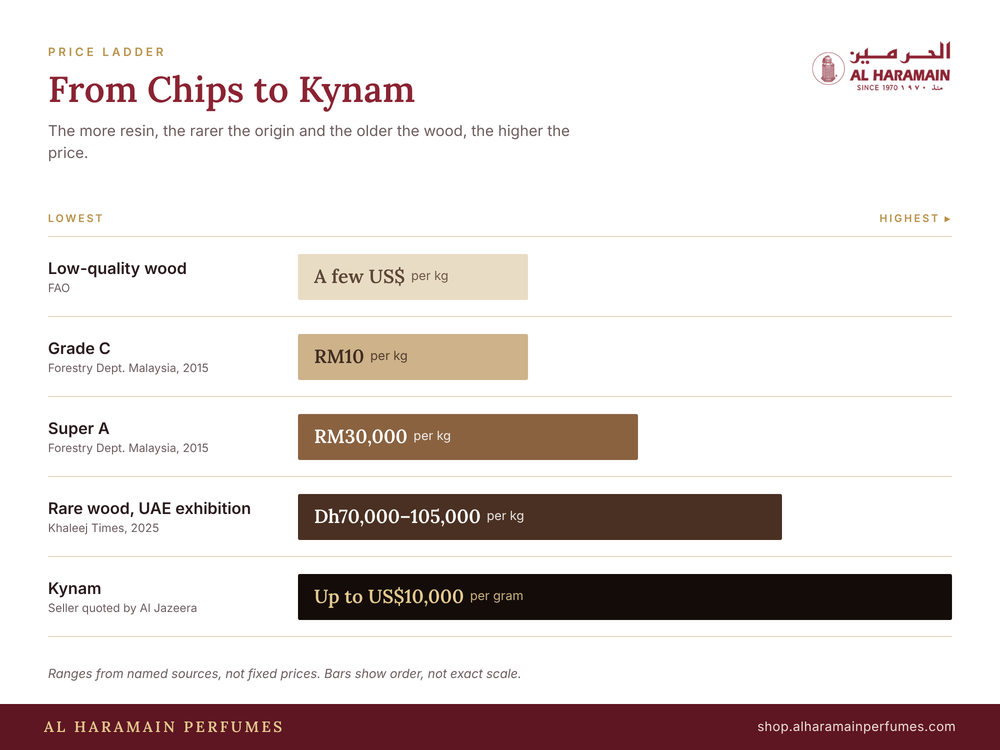
| Official grades, Super A to C | RM30,000 per kg (Super A) down to RM10 per kg (grade C) | Forestry Department Peninsular Malaysia, 2015 |
| Rare wood at a UAE exhibition | Dh70,000 to Dh105,000 per kg | Khaleej Times, 2025 |
| Pure oud oil | About US$10 to US$500 per gram (about AED 37 to AED 1,840) | Al Haramain |
| Kynam | Up to US$10,000 per gram | Seller quoted by Al Jazeera |
These are ranges, not fixed prices. Prices move with supply, demand and the quality of each individual piece.
How to Read Agarwood Prices: Per Gram, Per Kilogram and Per Tola
Much of the confusion around agarwood prices comes from the units. Sellers quote by the gram, the kilogram or the tola, and the same wood can sound cheap or expensive depending on which unit you hear.
- 1 kilogram = 1,000 grams
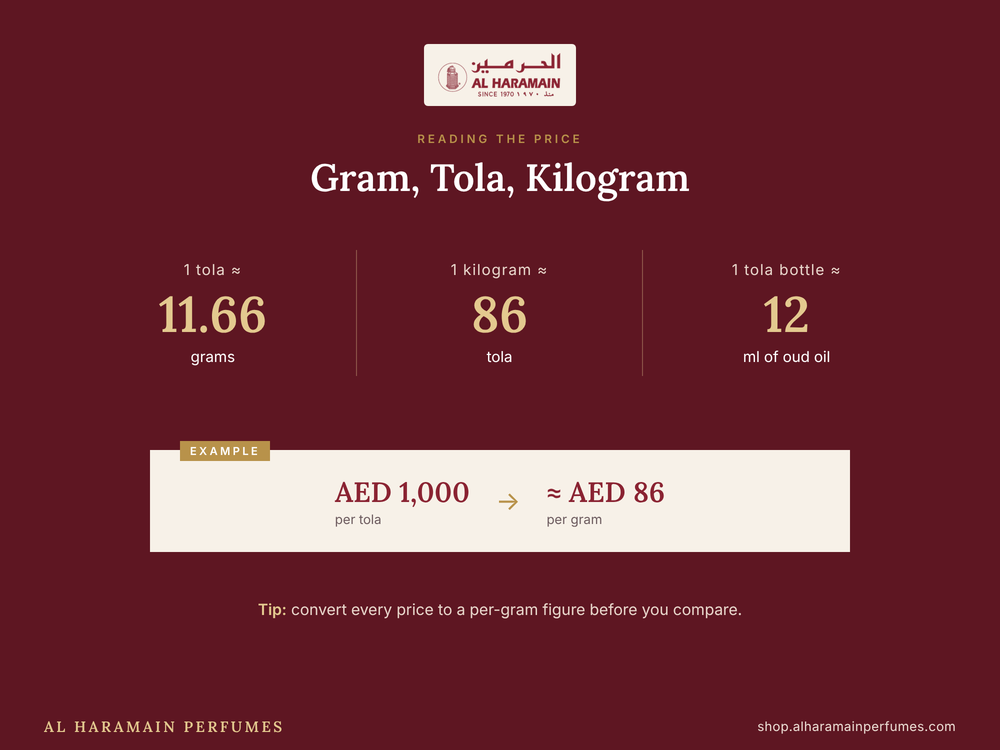
- 1 tola ≈ 11.66 grams, a traditional South Asian unit still widely used in Gulf oud shops
- 1 kilogram ≈ 86 tola
- A tola bottle of oud oil usually holds about 12 ml
A quick example: if an oud oil costs AED 1,000 per tola, that works out to about AED 86 per gram. Converting every price to a per-gram figure is the simplest way to compare offers fairly.
Agarwood Price by Grade
Grade has the biggest single effect on price, because grade reflects how much fragrant resin the wood holds. The clearest official figures come from the Forestry Department of Peninsular Malaysia, whose 2015 grading manual listed indicative market prices for each grade:
| Grade | What it looks like | Indicative price (2015) |
|---|---|---|
| Super A | Large, shiny black, resin-saturated blocks | RM30,000 per kg |
| A | Black, rich in resin | RM20,000 per kg |
| B | Brown, medium resin | RM10,000 per kg |
| C | Cream, low resin | RM10 per kg |
The gap between grade B and grade C, from RM10,000 to RM10 per kilogram, shows just how much resin matters. Above these official grades sit sinking-grade wood, so dense with resin that it sinks in water, and Kynam, the rarest agarwood of all. If you'd like to understand what each grade means, Al Haramain's guide to agarwood grades explains them in detail.
Agarwood Price by Origin
Where agarwood comes from shapes both its scent and its price. At the Emirates Perfumes and Oud Exhibition at Expo Sharjah in 2025, sellers quoted these prices per kilogram, as reported by Khaleej Times:
- Tarakan (Indonesia): about Dh105,000
- A Philippine variety: more than Dh100,000, up from about Dh10,000 in 2017
- Imphal Super (India): about Dh85,000
- Malino: about Dh70,000
These are sellers' asking prices for some of the best wood at the show, not everyday retail prices. Still, they show two important things. First, rare origins command huge premiums. Second, prices can rise sharply as wild supply shrinks, as the Philippine example shows: roughly a tenfold increase in under a decade.
As a general guide, wild wood from Vietnam, Cambodia, Indonesia and India sits at the top of the market, while origins with more plentiful or cultivated supply tend to be more affordable.
Agarwood Price by Form
Agarwood is sold in several forms, and each is priced differently.
Oud Chips Price
Chips are the most common way to buy agarwood for burning at home. They are sold by weight, by the gram, tola or kilogram, and their price depends on grade and origin. Everyday chips are lighter, with less resin, and are affordable enough for daily use. Premium chips are darker and denser, and the best of them sink in water.
On Al Haramain's agarwood collection for the UAE, packs ranged at the time of writing from about AED 30 for Cambodi dust to over AED 900 for premium Philippine agarwood. Pack sizes vary between products, so always compare the price per gram.
Agarwood Powder and Dust
Powder and dust are the most affordable ways to enjoy real agarwood. Finely ground wood is burned on its own or used to make bakhoor and incense. If you want an everyday scent at a lower price, blended incense is another option, and Al Haramain's bukhoor collection includes many choices.
Oud Oil Price per Tola
Oud oil, known in the Gulf as Dehn Al Oudh, is the most concentrated and often the most expensive form of agarwood. The oil yield is tiny, usually well under one percent of the wood's weight, and the best oils are aged for years. Pure oud oil can range from about US$10 to US$500 per gram, which puts a full tola of the finest oil in the thousands of dollars.
At the time of writing, Al Haramain's UAE store listed a 3 ml Dehnal Oudh Cambodi at AED 135 and a 12 ml Dehnal Oudh Maliki Ateeq at about AED 1,580. You can compare oils in Al Haramain's Dehnal Oudh range, and Al Haramain's guide to Dehn Al Oudh explains how the oil is made and graded. If you prefer blended oils at lower prices, Al Haramain's concentrated perfume oils include many oud-based options.
Collector Pieces and Showpieces
At the very top of the market, large natural pieces are priced individually rather than by weight. Al Haramain's collection includes a 7.4 kg Burmese piece valued at AED 10 million and a 2.4 kg Vietnamese piece valued at AED 3 million, which works out at more than a million dirhams per kilogram for each. You can read about these pieces in the story of Al Haramain's agarwood collection.
Oud Wood Prices in the UAE
For most buyers in the UAE, oud wood falls into three price bands:
- Everyday chips, powder and bakhoor: the most affordable, ideal for daily home fragrance.
- Premium chips: a clear step up in price, chosen for guests, the majlis, weddings and Eid.
- Sinking grade, rare origins and collector pieces: priced in the thousands to millions of dirhams, mostly bought by collectors and for important gifts.
Prices in the UAE also move with the calendar. Demand rises before Ramadan, Eid, the wedding season and National Day, and rare wood can become harder to find at those times. The best way to understand real prices is to compare a few pieces side by side in a showroom, where you can see, weigh and smell the wood before you pay.
Why Is Agarwood So Expensive?
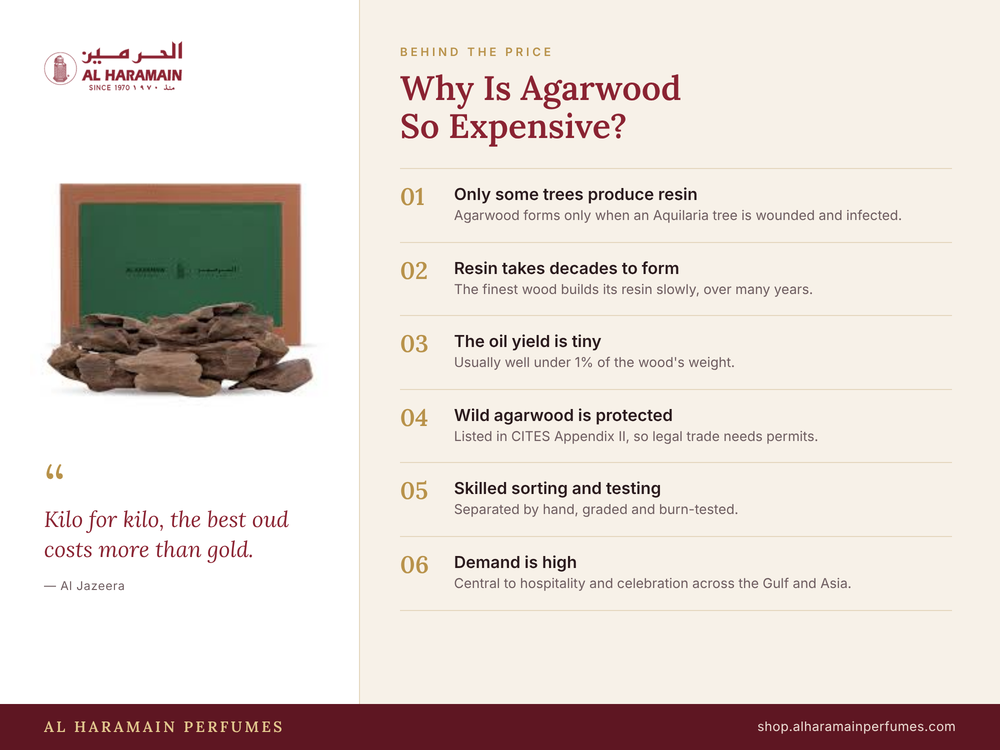
Agarwood is one of the most expensive natural materials in the world. In its investigation into the oud trade, Al Jazeera reported that, kilo for kilo, the best oud costs more than gold. Several factors combine to push the price so high.
Only Some Trees Produce Resin
Agarwood forms only when an Aquilaria tree is wounded and infected, and the tree protects itself by producing a dark, fragrant resin. A healthy tree has pale, almost scentless wood. Only a small share of wild trees ever produce good resin, and there is no reliable way to tell from the outside.
Resin Takes Decades to Form
The finest agarwood builds its resin slowly, over many years. Old wild trees produce the richest and most complex wood, and the very best pieces can be centuries old. That kind of time cannot be rushed, which is why truly old wood is so rare.
The Oil Yield Is Tiny
Distilling oud oil takes a huge amount of wood. The yield is usually well under one percent of the wood's weight, so a small bottle of oil can take many kilograms of agarwood, along with months of soaking, days of distilling and years of ageing.
Wild Agarwood Is Protected
Decades of over-harvesting have made wild agarwood scarce. All agarwood-producing species are now listed in Appendix II of CITES, the convention that controls international trade in endangered species, so legal trade needs permits and records. Limited legal supply keeps prices high.
Skilled Harvesting, Sorting and Testing
Good agarwood is separated from the pale wood around it largely by hand, then sorted by size, colour and density and tested by burning. Each step takes skill and time, and every one adds to the cost of the finished wood.
Demand Is High
Agarwood is central to hospitality, celebration and faith across the Gulf, and it is also prized in South and East Asia. With strong demand and limited supply, prices for the best wood keep rising.
The Most Expensive Agarwood in the World: Kynam
The most expensive agarwood of all is Kynam, also written Ky Nam or Qi Nan, and known in Japan as Kyara. It is soft, extremely rich in resin and fragrant even at room temperature, and very little is found each year, mostly from old wild trees in Vietnam.
Its prices are extraordinary. One oud seller told Al Jazeera that Kynam can cost $10,000 for a single gram, and described a sale in Shanghai of two kilograms for US$18 million. Al Haramain's own collection includes a natural, sinking-grade Kynam about 200 years old, the finest piece it holds.
Wild vs Cultivated Agarwood: The Price Difference
Wild agarwood from old trees commands the highest prices. Its resin has built up naturally over many years, which gives it a richer, more complex scent, and wild supply is limited and protected.
Cultivated agarwood is grown on plantations, where trees are deliberately treated to start resin production. It is far more affordable and more consistent, and it reduces pressure on wild trees, though it is usually less complex than old wild wood. For daily use, good cultivated wood offers excellent value. For special occasions and collecting, wild wood is worth the premium.
How to Get Fair Value When Buying Agarwood
Because prices vary so much, a few habits will help you pay a fair price for what you actually get.
- Compare per gram, not per box. Convert every price to a per-gram figure before comparing.
- Ask the grade and origin. A good seller can tell you where the wood comes from and how it was graded.
- Ask to burn a sample. Good wood gives a smooth, rich smoke. Harsh or sharp smoke is a warning sign, whatever the price.
- Be wary of bargains. "Sinking grade" or "Super" wood at a very low price is a red flag.
- Start small. Buy a small amount of a new origin or grade before investing in more.
- Buy from a trusted house. Agarwood is a protected species, so choose a seller with legal, documented supply.
- Keep your receipt. It records what you were sold, and at what grade and price.
Agarwood at Al Haramain: From Everyday Chips to Collector Pieces
Al Haramain began as an agarwood trader near Al Haram Mosque in Makkah in 1970, and agarwood has been at the heart of the house for more than 55 years. Today it holds wood from ten countries, in every grade from powder and everyday chips to sinking-grade pieces and a 200-year-old Kynam.
Every piece follows the same path. It is bought at origin, sorted by size, colour and density, and burn-tested, with each batch tested at least three times before it is approved. All of it is natural agarwood, never synthetic. For businesses buying in volume, Al Haramain also supplies agarwood wholesale, from kilograms to tonnes, as explained in Al Haramain's agarwood wholesale and export guide.
Frequently Asked Questions
How much does agarwood cost per kg?
Agarwood prices per kilogram vary enormously. Low-quality wood can cost just a few US dollars per kilogram, while top-quality wood can sell for more than US$30,000 per kilogram, according to the FAO. At a 2025 oud exhibition in Sharjah, sellers quoted Dh70,000 to Dh105,000 per kilogram for rare wood. Grade, origin, age and whether the wood is wild or cultivated make the difference.
How much is one tola of oud oil?
One tola is about 11.66 grams, and a tola bottle usually holds about 12 ml of oil. Pure oud oil can range from about US$10 to US$500 per gram, so a tola can cost anything from a little over US$100 to several thousand dollars. Price depends on origin, grade and age, with first-grade and long-aged ateeq oils costing the most. Always check whether a price is per gram, per tola or per bottle.
What is the price of oud chips in the UAE?
In the UAE, oud chips range from affordable everyday packs to premium wood costing hundreds or thousands of dirhams. On Al Haramain's UAE online store, packs ranged at the time of writing from about AED 30 for Cambodi dust to over AED 900 for premium Philippine agarwood. Rare and sinking-grade wood sold by weight can cost far more. Compare prices per gram, as pack sizes differ.
Why is agarwood more expensive than gold?
Only a small share of Aquilaria trees ever produce the fragrant resin, and the best resin takes decades to form. Wild trees are protected and scarce, the work of harvesting and sorting is skilled and slow, and the oil yield is tiny. Demand across the Gulf and Asia remains high. Together, these factors mean that, kilo for kilo, the best oud can cost more than gold.
What is the most expensive agarwood?
Kynam, also called Ky Nam, Qi Nan or Kyara, is the most expensive agarwood in the world. An oud seller quoted by Al Jazeera put its price at up to US$10,000 per gram, and described a sale of two kilograms in Shanghai for US$18 million. It is soft, extremely rich in resin and fragrant even without heat, and very little is found each year. Below Kynam, sinking-grade wood from rare wild origins is the most valuable.
Is cheap agarwood fake?
Not necessarily. Lower-grade and cultivated agarwood is genuine and can be very affordable, and powder and everyday chips are meant to be budget-friendly. The warning sign is a mismatch: wood sold as "sinking grade", "Super" or rare wild origin at a very low price. If the wood smells strongly perfumed before it is warmed, or gives a harsh smoke, be cautious and buy from a trusted seller.
Do agarwood prices change over time?
Yes. Prices depend on supply and demand, and wild supply has been shrinking for decades. Khaleej Times reported that one Philippine variety rose from about Dh10,000 per kilogram in 2017 to more than Dh100,000 by 2025. Prices also rise around Ramadan, Eid and the wedding season, when demand in the Gulf is highest.
Where can I buy agarwood at a fair price in the UAE?
Buy from an established house with clear grading and legal, documented supply. Al Haramain Perfumes sells agarwood in several origins and grades in its showrooms across the UAE and on its UAE online store. In a showroom, you can see, weigh and smell the wood, and the team can burn a sample for you. For collector pieces or larger quantities, contact the oud team on WhatsApp at +971 6 748 0555.
Final Thoughts
Agarwood prices can look confusing, but they follow a simple logic: the more resin, the rarer the origin and the older the wood, the higher the price. Learn to compare by the gram, ask about grade and origin, and trust your nose when the wood is warmed, and you'll know when a price is fair. To compare grades and origins for yourself, visit an Al Haramain showroom in the UAE or browse the full agarwood range at Al Haramain Perfumes UAE.