Agarwood Grades Explained: How to Judge Oud Wood Quality Before You Buy
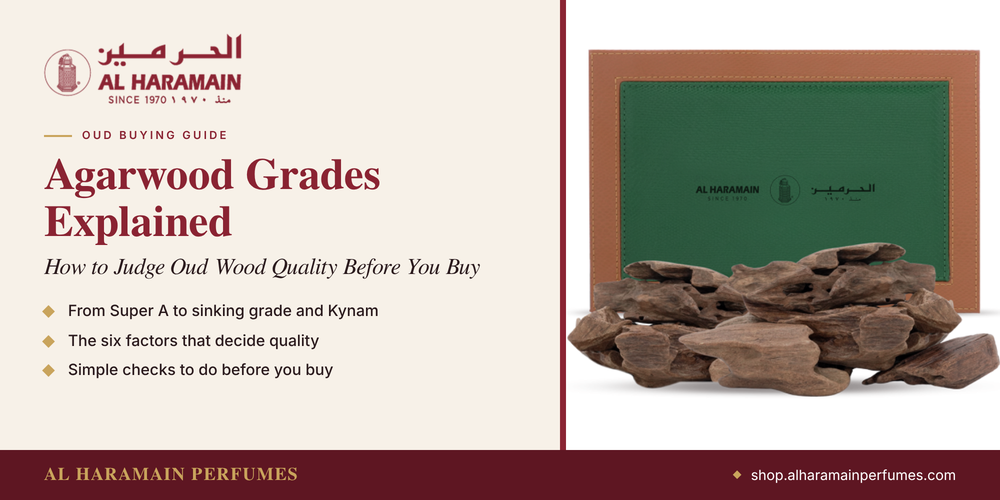
Walk into any oud shop in Dubai, Sharjah or Abu Dhabi and you'll hear the same words again and again: Super, Double Super, Royal, sinking grade. Two pieces of agarwood can look almost identical in the box and still differ hugely in scent and price. That is why grades matter, and why they confuse so many buyers.
The short answer is this: there is no single worldwide standard for agarwood grades. Wood is graded mainly by how much resin it holds, which shows in its colour, weight, density and scent. The best-known official scale, used in Malaysia, runs from Super A down to A, B and C. Wood that sinks in water sits at the top, and Kynam sits above every grade. This guide explains each system, the factors behind a grade, and how to choose the right oud wood for your home in the UAE.
What Are Agarwood Grades?
An agarwood grade is a quality class given to a piece of oud wood. It mainly reflects how much aromatic resin has built up inside the wood. Agarwood forms when an Aquilaria tree is wounded and infected, and the tree protects itself by producing a dark, fragrant resin that slowly fills the heartwood. The more resin a piece holds, the darker, heavier and more fragrant it is, and the higher its grade.
Grade decides three things that matter to a buyer: how the wood smells when warmed, what it is best used for, and how much it costs. If you'd like the background on how agarwood forms in the first place, Al Haramain's guide to what oud is explains it simply.
Why There Is No Single Worldwide Grading Standard
Agarwood is graded by traders, collectors and, in some countries, government authorities, and each uses its own scale. A 2017 review in the journal Chinese Herbal Medicines noted that there is no standard grading system used around the world. A 2013 study by the Forest Research Institute Malaysia went further, describing traditional grading by colour, density and scent as "very subjective" and dependent on individual perception and experience.
For a buyer, this has one practical consequence: the same label can mean different quality from different sellers. A "Super" from one shop may not match a "Super" from another. Understanding what sits behind a grade lets you judge the wood itself rather than the name on the box.
The Main Agarwood Grading Systems
Super A, A, B and C: The Official Malaysian System
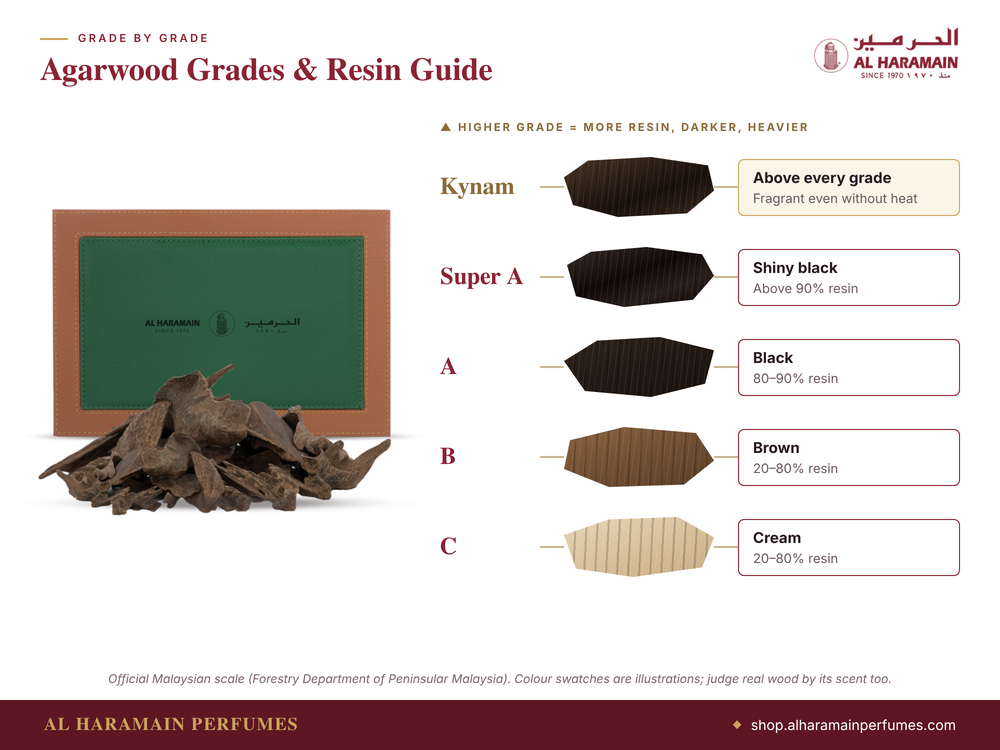
The clearest published scale comes from the Forestry Department of Peninsular Malaysia, which grades agarwood (known locally as gaharu) into four classes. Its official grading guide sets out the criteria:
| Grade | Colour | Resin content | Scent | Main use |
|---|---|---|---|---|
| Super A | Shiny black | Above 90% | Very strong | Large blocks over 3 kg, kept for decoration and their aesthetic value |
| A | Black | 80–90% | Strong | Burning as incense, aromatherapy |
| B | Brown | 20–80% | Medium | Burning as incense, aromatherapy |
| C | Cream | 20–80% | Weaker | Oil extraction, decoration |
Colour is the first thing graders look at, with density, size and smell used to confirm the grade. Super A is reserved for large, solid, resin-saturated blocks, which are exceptionally rare.
Grading by Resin Content (A to D)
Because visual grading depends so much on the person doing it, researchers have looked for a more objective measure. A study in the Journal of Tropical Forest Science proposed grading agarwood by its measured resin content:
- Grade A: 30% resin and above
- Grade B: 20% to just under 30%
- Grade C: 9% to just under 20%
- Grade D: below 9%
When the researchers tested wood that traders had already graded, most matched, but several did not. Some samples sold as grade C fell into the lowest resin group, while one grade B sample fell into the highest. It is a useful reminder that a label is a seller's judgement, not a guarantee.
Trade Names You'll Hear in the Gulf: Super, Double Super, Royal and No.1
In oud shops across the Gulf, you're more likely to hear trade names than official grades. The same Malaysian study recorded traders using labels such as Super, Double Super, C+, A5, OUD1 and OUD2, and wood is also sold under origin names or names chosen simply to attract buyers.
These names usually signal where a seller places a lot within their own range, with words like Super, Double Super and Royal used for their better wood. But there is no shared definition behind them, so their meaning changes from one seller to the next. Treat a trade name as a starting point, then judge the wood using the factors below.
Kynam (Ky Nam, Kyara): The Grade Above All Grades
Above every grade sits Kynam, also written Ky Nam or Qi Nan, and known in Japan as Kyara, the highest grade of Japanese incense wood. Kynam is soft, rich in resin and fragrant even at room temperature, without being heated. Very little true Kynam is found each year, mostly from old wild trees in Vietnam.
Al Haramain holds a natural, sinking-grade Kynam about 200 years old, the finest piece in its collection. You can read more about it in the story of Al Haramain's agarwood collection.
The Water Test: Sinking, Semi-Sinking and Floating Agarwood
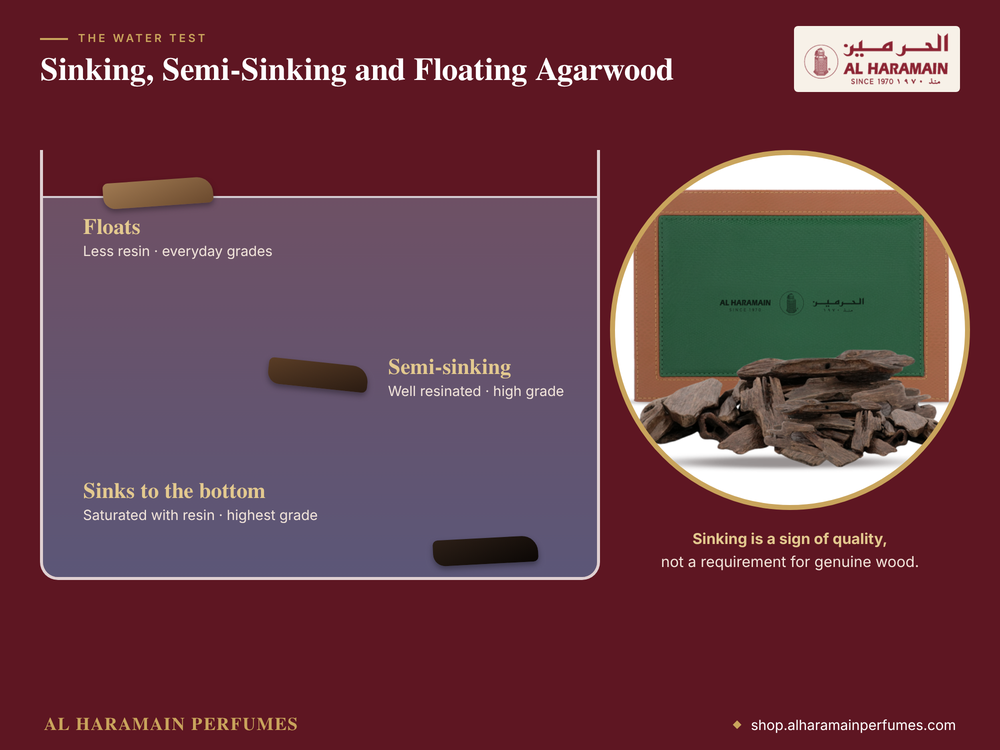
One of the oldest ways to judge agarwood is to place it in water. Healthy wood from the tree is pale and light, so it floats. As resin builds up over many years, the wood becomes denser, and the most resin-rich pieces sink. That is where the Chinese name for agarwood, chen xiang, comes from: it means "sinking fragrance".
| In water, the piece… | What it shows | Grade |
|---|---|---|
| Sinks to the bottom | Dense and saturated with resin | Highest (sinking grade) |
| Sinks below the surface but doesn't touch the bottom | Well resinated | High (semi-sinking) |
| Floats | Less resin | Everyday grades |
Sinking is a sign of quality, not a requirement for genuine wood. Many good, real pieces float, and scent and origin matter just as much. Sinking grade is simply the rarest and most prized.
Six Factors That Decide an Agarwood Grade
Whatever the label, these six factors are what graders, traders and experienced buyers actually look at.
Resin Content
Resin is the heart of agarwood and the main driver of its grade. The resin carries the fragrance, so more resin means a richer scent, a longer burn and a higher value. Everything else on this list, from colour to weight, is really a way of reading how much resin a piece holds.
Colour
Grades move from cream and yellow at the bottom, through brown, to deep black at the top. Dark veins and patches show where resin has gathered. Colour is a quick first check, but it can mislead on its own: light can make wood look darker than it is, and colour should always be read together with weight and scent.
Density and Weight
Resin is heavier than the pale wood around it, so a high-grade piece feels heavy for its size. The densest pieces sink in water. If two chips of the same size feel very different in your hand, the heavier one usually holds more resin.
Scent, Cold and Warmed
Good agarwood smells faint and pleasant when cold, then opens up when warmed, giving a smooth, rich and often sweet smoke. A harsh, sharp or chemical smell is a warning sign. Kynam is the rare exception that is clearly fragrant even without heat.
Origin
Where agarwood grows shapes its character. Vietnamese and Cambodian wood tends to be sweet and honeyed, Indian wood deep and strong, and Indonesian wood rich and varied. Origin doesn't decide grade on its own, since every origin produces higher and lower grades, but it decides the style of scent you'll get.
Age, and Wild vs Cultivated Wood
Resin builds slowly, so age matters. Wood from old wild trees is usually the most complex and the rarest. Cultivated agarwood from plantations is more affordable and helps protect wild trees, though it is generally less complex. Both have a place: wild wood for special occasions and collectors, cultivated wood for everyday use.
Agarwood Grades by Origin
Every origin produces a range of grades, but each has its own character. This table covers the ten origins Al Haramain holds.
| Origin | Typical character | What Al Haramain holds |
|---|---|---|
| Vietnam | Sweet, smooth, honeyed | Premium wild agarwood and Kynam |
| Cambodia | Fruity, sweet, balsamic | Several grades, including Cambodia Super |
| Burma (Myanmar) | Deep, earthy, warm, smoky | Large natural pieces and premium chips |
| Philippines | Sweet, clean, woody | Premium agarwood |
| Indonesia | Rich, sweet to sharp | Rare wild pieces, including Kalimantan and Sumatra |
| India | Strong, deep, long-lasting | Hindi agarwood, cleaned and graded |
| Bangladesh | Deep, rich, warm | Natural forest agarwood |
| Laos | Soft, sweet, gentle | Several grades |
| Malaysia | Clean, sweet, woody | Several grades |
| Sri Lanka | Light, fresh | Several grades |
Several of these origins are available as chips in Al Haramain's agarwood collection, including Al Haramain's Cambodia Super agarwood and Al Haramain's Burma agarwood.
Which Agarwood Grade Should You Buy?
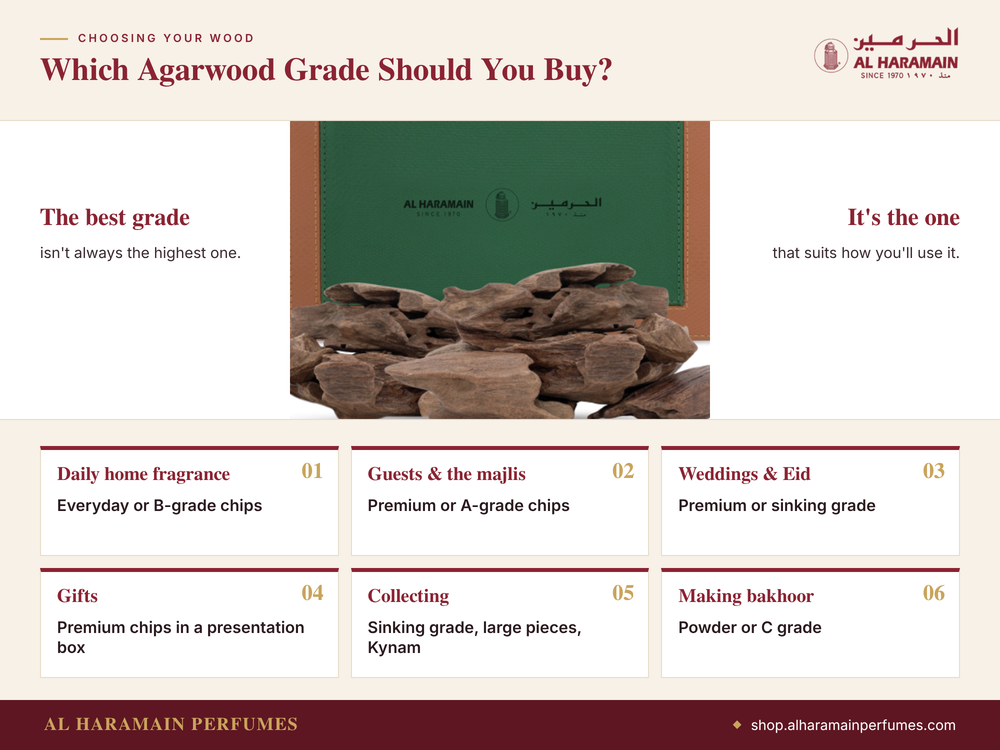
The best grade isn't always the highest one. It's the one that suits how you'll use it.
| How you'll use it | Recommended grade | Why |
|---|---|---|
| Daily home fragrance | Everyday or B-grade chips | A pleasant scent at a sensible price for regular burning |
| Welcoming guests and the majlis | Premium or A-grade chips | A richer smoke that shows hospitality |
| Weddings and Eid | Premium or sinking grade | A deep, lasting scent for the most important days |
| Gifts | Premium chips in a presentation box | Impressive, and easy for anyone to enjoy |
| Collecting | Sinking grade, large natural pieces, Kynam | Rarity, age and value |
| Making bakhoor | Powder or C grade | Lower-resin wood blends well with oils and other ingredients |
If you prefer a ready-made blend for everyday burning, Al Haramain's bukhoor collection is a more affordable alternative to pure chips.
How to Check Agarwood Quality Before You Buy
You don't need a laboratory to judge agarwood. These simple checks, done in a showroom, will tell you a lot.
- Look closely. Check for dark resin veins and an even, natural colour. More dark resin usually means a higher grade.
- Feel the weight. A good piece feels heavy for its size. Compare two chips of similar size if you can.
- Smell it cold. Real agarwood smells faint and woody before it is heated. A strong perfume smell from cold wood suggests added fragrance.
- Warm a small piece. Ask to burn a sample. Good wood gives a smooth, rich, slowly rising smoke. Harsh or sharp smoke is a warning sign.
- Ask about origin and grade. A trustworthy seller can tell you where the wood comes from and how it was graded.
- Be wary of bargains. A very low price for wood sold as "sinking grade" or "Super" is a red flag.
- Buy from a trusted house. Agarwood is protected under CITES, so reputable sellers trade it with the proper permits and records.
Warning Signs of Treated or Low-Quality Wood
Adulteration of agarwood is a known problem in the trade. Be cautious if the wood smells strongly perfumed before it is warmed, feels oily or greasy on the surface, looks unnaturally and evenly black, or gives off a harsh, chemical smoke. Natural resin forms unevenly, in veins and patches, so wood that looks too uniform deserves a closer look.
How Al Haramain Grades Its Agarwood
Al Haramain began as an agarwood trader near Al Haram Mosque in Makkah in 1970, and grading wood has been at the heart of the business for more than 55 years. Today the house holds agarwood from ten countries, and every piece follows the same path before it reaches a customer.
Wood is sourced at origin, from forest collectors and from the private collections of merchants and connoisseurs. The chairman, Mohammed Mahtabur Rahman, has spent 50 years selecting agarwood and amber, and he personally visits forests in Kalimantan, Sumatra and other parts of Indonesia to find rare raw material.
Back in Ajman, each piece is sorted again and again by size, colour and density, with almost no tolerance for defects. Then it faces the most important test of all: fire. Hundreds of chips are burned every day, and each batch is tested at least three times before it is approved, because burning is the only test that shows how the wood will really smell in your home. All of it is natural agarwood, never synthetic oud.
How Grade Affects Agarwood Price
Grade is the biggest single factor in the price of agarwood, and the gap between grades is enormous. In the Malaysian Forestry Department's 2015 grading manual, indicative prices ranged from about RM30,000 per kilogram for Super A and RM20,000 for grade A, down to RM10,000 for grade B and just RM10 for grade C.
In the UAE, rare wood can command far higher figures. At the Emirates Perfumes and Oud Exhibition in Sharjah in 2025, sellers quoted prices of around Dh70,000 to Dh105,000 per kilogram for top wood from Malaysia, India and Indonesia, as reported by Khaleej Times. Origin, rarity, age and scent all push the price up or down within each grade.
Frequently Asked Questions
What is the highest grade of agarwood?
Kynam, also called Ky Nam, Qi Nan or Kyara, is regarded as the highest grade of agarwood. It is soft, very rich in resin and fragrant even without heat, and very little is found each year, mostly from old wild trees in Vietnam. Below Kynam, sinking-grade wood is the most prized. In the Malaysian official scale, Super A is the top grade, reserved for large, shiny black blocks with more than 90% resin.
What does "Super" or "Double Super" agarwood mean?
Super and Double Super are trade names used by sellers, not official grades. They are generally used for a seller's better wood, but there is no shared definition behind them, so their meaning differs from shop to shop. Research from Malaysia has found that trader labels don't always match the wood's actual resin content. Judge the wood by its colour, weight and scent when warmed, not just the label.
What is grade A agarwood?
In the Malaysian official system, grade A agarwood is black wood with 80 to 90% resin, a strong scent and pieces under 3 kg, used mainly for burning as incense and in aromatherapy. It sits just below Super A, which is reserved for large decorative blocks. Other systems use "A" differently: in a resin-based scale proposed by researchers, grade A simply means 30% resin or more.
Does real agarwood always sink in water?
No. Sinking is a sign of very high resin content, but it is not a requirement for wood to be genuine. Many good-quality, real pieces float or sit just below the surface. Sinking grade is simply the rarest and most valuable class. Scent, origin and how the wood burns matter as much as the water test.
How can I tell high-grade agarwood by its smell?
High-grade agarwood smells faint and woody when cold, then opens up into a smooth, rich and often sweet scent when gently warmed. The smoke rises slowly and stays pleasant, without stinging the nose. A harsh, sharp or chemical smell usually points to low-grade or treated wood. The rare exception is Kynam, which is fragrant even at room temperature.
Is wild agarwood better than cultivated agarwood?
Wild agarwood from old trees is usually richer and more complex, because its resin has built up naturally over many years, and it is far rarer and more expensive. Cultivated agarwood is grown on plantations, is more affordable and helps reduce pressure on wild trees. For special occasions and collecting, wild wood is prized. For everyday burning, good cultivated wood is a sensible choice.
Which agarwood grade is best for daily use at home?
For daily use, everyday or B-grade chips are usually the best choice. They give a pleasant, warm scent at a price that makes regular burning practical. Save premium and sinking-grade wood for guests, weddings and Eid. If you prefer a blended scent, bukhoor is another affordable option for everyday use.
Where can I buy graded agarwood in the UAE?
You can buy agarwood in several origins and grades at Al Haramain Perfumes showrooms across the UAE and on the Al Haramain UAE online store. In a showroom, you can see, weigh and smell the wood before choosing, and the team can burn a sample for you. For collector pieces or larger quantities, contact the oud team on WhatsApp at +971 6 748 0555.
Final Thoughts
Agarwood grades can seem complicated, but they all come back to one thing: resin. Colour, weight, the water test and scent are simply ways of reading how much resin a piece holds, and how good it will smell when warmed. Since labels vary from seller to seller, the safest approach is to learn these signs, test the wood yourself and buy from a house you trust. To see the grades for yourself, visit an Al Haramain showroom in the UAE or browse Al Haramain Perfumes online.